
Chilled Water Systems
Design, installation, planned maintenance and reactive cover for chilled water and process cooling plant across London, Essex and Kent — from a single packaged chiller on one machine to a plant room serving a whole building.
What a chilled water system does
Rather than cooling every load with its own refrigeration circuit, a chilled water system cools one thing — water, or more usually a water and glycol mix — and pumps it round a closed circuit to wherever the heat is. That might be the cooling coils in air handling units and fan coils, or it might be the moulding tool, the jacketed vessel or the laser that would otherwise cook itself.
The reason process engineers keep choosing it is that one plant serves many loads, and extending the system means extending pipework rather than buying another machine. There is a compliance benefit too: the refrigerant charge stays in the chiller in the plant room instead of being distributed around the building in refrigerant pipework, which keeps F-Gas leak checking contained to one place. How those checks are calculated is covered on our F-Gas compliance page.
The trade-off is that a chilled water system is a mechanical system as much as a refrigeration one. Pumps, pressurisation, water quality, air and dirt in the circuit, and the state of the pipework all decide whether the chiller ever gets to do its job. We cover both sides of that, which is the reason most of our chilled water clients came to us in the first place.
What we do on chilled water plant
Reactive, planned and installation work — on our own contracts and on behalf of equipment manufacturers — for the best part of sixty years.
Reactive breakdown cover
A chiller down is a production line down. Our engineers carry common spares, and we can arrange temporary hire plant where a repair is going to take longer than the process can wait.
Planned preventative maintenance
Scheduled visits at a frequency that suits the plant and its duty, with statutory F-Gas leak checking and record keeping handled on the same visit rather than billed as a separate exercise.
Installation and plant replacement
New systems from scratch, and like-for-like or upgraded chiller replacements on live sites — including the rigging, pipework alterations and commissioning around a shutdown window.
Pipework, pumps and plant rooms
Circulating pumps, pressurisation units, buffer vessels, air and dirt separators, and the pipework tying it all together. The mechanical side is in-house, not subcontracted.
Controls and electrical
Panels, inverters, sensors and BMS interfaces, carried out by NICEIC approved electrical engineers, so the power and the controls are not somebody else's problem.
Water quality and system health
Glycol concentration, inhibitor levels, strainer and separator condition, flow rates and temperature differentials — the things that quietly cost a system its efficiency long before it fails.
The equipment we work on
We install, maintain and repair industrial cooling equipment from the specialist UK manufacturers, including many years of installation, planned maintenance and reactive work on F&R Products chillers and coolers. The duties below are what each class of equipment covers; which one is right depends on the load, the water temperature the process needs, and what the site can physically take.
Packaged water chillers
Air-cooled and water-cooled packaged units with integral tank, pump and controls, from well under a kilowatt up to around 160 kW in a single machine, and considerably more in multiples.
Tank immersion and coil-in-tank units
Evaporator coils dropped into a customer's own tank, including units built for emulsions and cutting oils rather than plain water, and potable-water variants for food and drink production.
Laboratory and instrument chillers
Small close-control packaged units serving analytical instruments, test rigs and lab equipment, where the tolerance on water temperature matters far more than the duty.
Dry air coolers
Free-standing and fully packaged air blast coolers from around 10 kW to over 1,000 kW, cooling process water in a sealed circuit with no exposure to airborne contamination.
Adiabatic coolers
Dry coolers with a fine mist sprayed across the coil in high ambients, taking water off temperatures down towards the wet bulb rather than the dry bulb on the few days a year it matters.
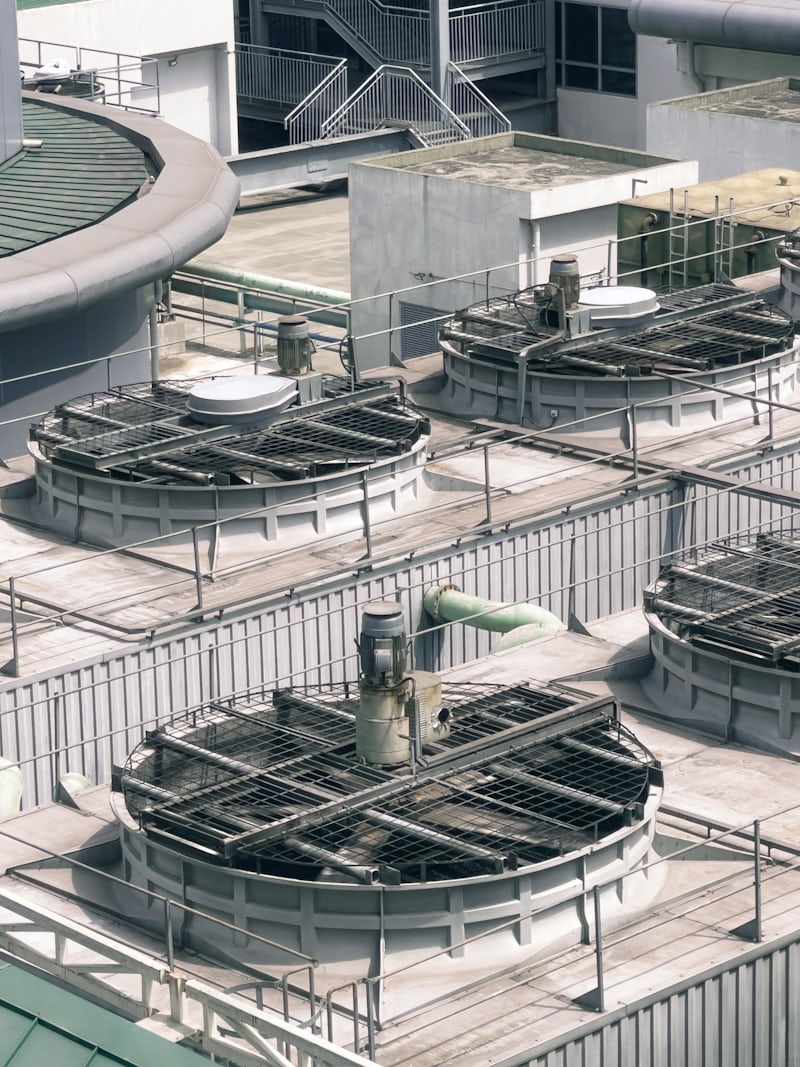
Evaporative cooling towers
Induced and forced draught towers, still the cheapest way to reject a large heat load — at the cost of water treatment, open-circuit contamination and Legionella duties under ACOP L8.
Free cooling: not everything needs a compressor
A great deal of process cooling is asked for at water temperatures a dry air cooler can reach on its own. A sealed dry cooler will typically bring process water to within about 3°C of ambient, and an adiabatic cooler — misting the coil only when the ambient demands it — to within roughly 5°C of the wet bulb. In the UK climate that covers a great many operating hours a year.
Sequencing a dry or adiabatic cooler ahead of the chiller, so the refrigeration only runs when the air alone cannot do the job, is usually the single biggest saving available on an existing system. It is also the change most often missed, because it is a controls and pipework job rather than a new machine.
Evaporative towers go colder still, below ambient, but they are open circuit: water treatment, tower cleaning and Legionella risk management under ACOP L8 come with them. We will give you a straight answer on which of the three suits your process and your appetite for maintenance.
What a maintenance visit covers
- Glycol concentration and inhibitor levels tested, not assumed
- Strainers, air and dirt separators checked and cleaned
- Condenser coils cleaned and airflow verified
- Pump, inverter and pressurisation unit performance
- Flow rates and temperature differential across the load
- Refrigerant leak checking and F-Gas records updated
- Controls, sensor calibration and frost protection
- Electrical inspection of panels and safety devices
Where we see it
- Injection moulding and plastics processing
- Food and beverage production and bottling
- Printing presses and drying lines
- Laser cutting, welding sets and induction furnaces
- Hydraulic power packs, compressors and vacuum pumps
- Quench tanks and heat treatment
- Laboratories, pharmaceutical and chemical processes
- Comfort cooling via AHU and fan coil circuits
- Universities, hospitals and other large estates
When the chiller is already down
Cooling failures do not wait for a convenient week. If the plant cannot be repaired inside the time your process can stand, temporary hire chillers can be brought in and piped up to keep production running while the permanent repair or replacement is arranged.
The same applies to planned work: a hire unit across a changeover means a chiller replacement need not cost you the fortnight it takes to do properly.
Related work sits on our refrigeration, mechanical and electrical pages.
Talk to us about your chilled water plant
Tell us what the process needs and what you have got now. We will survey it and give you a straight answer on repair, replacement or maintenance.